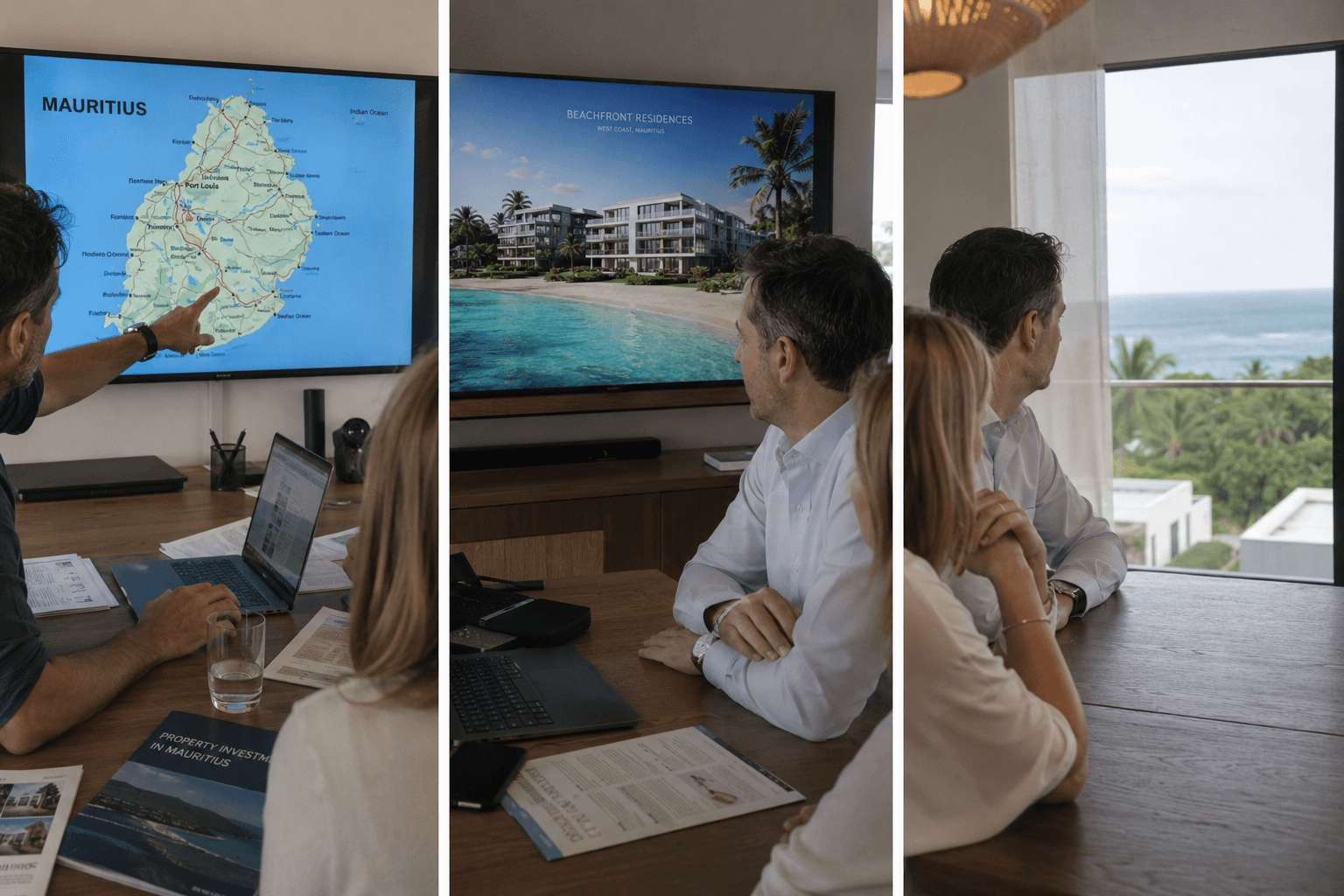

Why Invest in Mauritius Property
Mauritius property attracts foreign buyers through approved ownership routes, residence eligibility, tax efficiency and strong lifestyle appeal. Here is what to compare before you buy.


Why invest in Mauritius property? For many foreign buyers, Mauritius combines approved ownership routes, residence eligibility from USD 375,000, no capital gains tax and no exchange controls. Buyers can invest through PDS, Smart City, G+2 and IHS structures, with each route serving different goals depending on budget, location and intended use.
From 1 July 2026, transaction costs also become a more important part of the acquisition calculation. For non-citizen purchases under eligible routes, registration duty and land transfer tax move to 10% each in the cases provided for by the Finance Act 2025, so timing, pricing and scheme selection now deserve closer attention before signing.
For a more detailed comparison of how approved ownership routes differ in practice, see our overview of property investment schemes in Mauritius for foreign buyers.
How Foreign Buyers Can Own Property in Mauritius
Mauritius allows non-citizens to acquire residential property through specific approved routes rather than through unrestricted open-market purchase. In practice, the main structures used by foreign buyers today are the Property Development Scheme, Smart City developments, apartments in buildings of at least two floors above ground, and the Invest Hotel Scheme.
Scheme | Property type | Residence eligibility | What to know |
PDS | Villas and other residences in managed developments | Yes, from USD 375,000 | Often suited to buyers looking for estate living and strong residential positioning |
Smart City | Villas, apartments, duplexes and townhouses | Yes, from USD 375,000 | Mixed-use environments with residential, commercial and lifestyle infrastructure |
G+2 | Apartments in buildings with at least two floors above ground | Yes, from USD 375,000 | Most flexible apartment route for foreign buyers, with lower entry possible without residence eligibility |
IHS | Hotel-branded villas, suites or units | Yes, from USD 375,000 | Operates under a lease-back and hospitality model rather than standard independent ownership |
These routes are subject to EDB approval, identity and source-of-funds checks, and notarial conveyancing. For apartments, current EDB guidance states a minimum acquisition price of MUR 6 million or its equivalent in a hard convertible foreign currency, while residence eligibility under approved residential acquisitions remains linked to the USD 375,000 threshold.
International buyers should also review Can Foreigners Buy Property in Mauritius? for a clearer explanation of ownership routes, approval requirements and buyer eligibility.
Residence Eligibility
A non-citizen who acquires qualifying residential property for more than USD 375,000 under an approved route may be eligible for a residence permit for as long as the property is held. That makes property acquisition not only a lifestyle or investment decision, but also a practical residence pathway for buyers planning a longer-term presence in Mauritius.
Tax Advantages for Foreign Property Buyers in Mauritius
Mauritius remains attractive to international buyers because the property decision is not only about ownership access. It is also about how the holding structure works once the asset has been acquired. The tax framework, the ability to repatriate funds and the absence of exchange controls all contribute to that appeal.
No Capital Gains Tax
Mauritius does not levy capital gains tax under its tax framework. For most long-term buy-and-hold investors, that means gains realised on disposal are not taxed as capital gains, although activities that amount to trading can still be treated differently for tax purposes.
Extensive Double Tax Treaty Network
Mauritius also benefits from an extensive double tax treaty network, which is one reason it is often considered by internationally mobile investors looking at cross-border holding and estate planning. The treaty angle does not remove the need for tailored advice, but it does reinforce the island’s role as a recognised international investment jurisdiction.
Rental Income Taxation
Rental income is generally taxed as ordinary income. In broad terms, non-residents are taxed on Mauritius-source income, while tax residents may be taxed on a wider basis depending on their status and structure. This is one of the areas where local tax advice is worth obtaining before purchase, especially where rental strategy or holding structure matters.
Full Capital Repatriation and Payment Rules
Official EDB material states that there is no restriction on repatriation of funds or revenue raised from the sale or renting of the property. Mauritius also abolished exchange control years ago, which continues to support cross-border capital mobility.
That said, the payment mechanics for new acquisitions under the amended property regulations changed from 13 December 2024. For new acquisitions under the affected schemes, non-citizens who transfer funds from abroad in hard currency must pay 85% of the purchase price in Mauritian rupees, with the remaining 15% payable in foreign currency or MUR. Buyers should therefore understand both the investment logic and the practical payment structure before committing.
Why Mauritius Appeals to International Buyers
Tax efficiency alone does not sustain demand. Buyers also want an environment in which the asset can be used, occupied, rented or resold without unnecessary friction. In Mauritius, this often comes down to infrastructure, accessibility, services and the fact that different regions serve different buyer profiles.
Established Infrastructure
The north and west coasts offer the broadest concentration of amenities used by foreign buyers, including international schools, private healthcare, shopping areas, restaurants and lifestyle services. Smart City environments and larger managed developments also add a further layer of practical convenience through integrated planning and on-site facilities.
Tourism Supporting Rental Demand
Mauritius welcomed 1,436,250 tourist arrivals in 2025, according to official government figures. That does not translate automatically into identical rental performance across the island, but it does help explain why coastal locations with strong visitor appeal and established services continue to attract buyers focused on occupancy and rental potential.
Where to Buy Property in Mauritius
Mauritius is a small island, but not a single market. For foreign buyers, region can affect entry format, day-to-day lifestyle, expected rental profile and resale liquidity just as much as scheme choice.
North Coast
Grand Baie, Pereybere, Mont Choisy, Pointe aux Canonniers, Trou aux Biches, Bain Boeuf and Cap Malheureux form one of the most active foreign-buyer markets in Mauritius. The north offers the broadest apartment inventory available to eligible non-citizens, a mature tourism ecosystem and the strongest concentration of lifestyle and daily-use infrastructure. It generally suits buyers prioritising liquidity, convenience and short-term rental appeal.
If liquidity, established demand and day-to-day convenience matter most to you, our guide buying property on the North Coast of Mauritius explores this market in greater detail
West Coast
Tamarin and Black River appeal to buyers looking for a more outdoors-driven coastal lifestyle while still retaining practical infrastructure. The west attracts international buyers who value mountain and sea settings, strong year-round appeal and a balance between lifestyle use and rental potential. It is often a good fit for buyers who want something less tourism-saturated than Grand Baie without moving too far from established services.
To better understand the West’s balance between lifestyle appeal, practical infrastructure and year-round demand, explore our article on buying property on the West Coast of Mauritius.
East Coast
Belle Mare, Roches Noires, Beau Champ, Poste Lafayette, Palmar, Pointe d’Esny and Blue Bay tend to attract buyers seeking more space, privacy and a quieter coastal setting. The east is often associated with premium estates, lower-density living and strong second-home appeal, but it is generally less driven by convenience and immediate resale fluidity than the north or west.
If you are drawn to space, privacy and a more exclusive coastal rhythm, our article on buying property on the East Coast of Mauritius looks at this market more closely.
South Coast
Bel Ombre, Baie du Cap and related southern locations remain more niche for foreign buyers. Stock is more limited, foreign-accessible apartments are less common, and the appeal is usually tied to landscape, privacy and a longer-term lifestyle or capital-preservation perspective rather than immediate rental intensity. This region tends to suit buyers who are comfortable trading convenience for space and character.
For buyers considering a more private, lower-density setting with a longer-term lifestyle focus, our article on buying property in the South of Mauritius offers a clearer picture of the region.
Central Plateau
Moka, Ebène and their surroundings offer a different logic. Here, the attraction is not beachfront living but year-round practicality, proximity to business hubs and integrated urban-style environments, particularly within Smart City settings. The central plateau often suits buyers more interested in long-term residential occupancy, professional tenants and daily convenience than resort-style coastal positioning.
Those prioritising proximity to business hubs, schools and everyday practicality can read more in our article on buying property in the Central Plateau of Mauritius.
Property Costs and Taxes from 2026
The biggest recent shift for foreign buyers is not access, but cost. Mauritius still offers clear ownership routes, yet the tax burden attached to acquisition and resale under eligible non-citizen transactions becomes more material from 1 July 2026.
Purchase Taxes from 1 July 2026
Under the Finance Act 2025, where a transfer to a non-citizen falls within the specified categories, the duty on registration of the deed and the land transfer tax move to the rates set in the amended schedules with effect from 1 July 2026. In practical market terms, this is widely understood as 10% registration duty and 10% land transfer tax for the relevant transactions involving non-citizens and eligible residential property under EDB schemes or the specified statutory route.
For buyers, this means that acquisition budgets now need to be tested more carefully. Even where land transfer tax is legally associated with the seller side, the practical pricing impact still needs to be checked case by case. Buyers should confirm whether the overall pricing structure already reflects that tax exposure.
Additional Transaction Costs
Beyond registration duty, foreign buyers should also budget for notary fees, legal representation where used, bank charges for international transfers and currency conversion, and scheme-related administrative costs. Exact totals vary by transaction, but the important point is to ask for a full closing-cost breakdown before reservation or signature rather than relying on headline purchase price alone.
Rental Income and Tax
If the property is intended for rental use, the tax treatment of that income should be reviewed early. The applicable position depends on tax residence, source rules and the way the property is held. This matters particularly where the buyer’s strategy combines residence, part-time personal use and rental income across different jurisdictions.
IHS Specific Considerations
IHS property should not be approached in the same way as a standard apartment or villa purchase. It is a hospitality-based ownership model in which the asset forms part of a hotel environment and is subject to an operator agreement.
Current official EDB material states that the owner must lease the unit back to the hotel and may use it for up to 180 days over a 12-month period. The practical attractiveness of IHS lies in hotel services and lower day-to-day management involvement, but the trade-off is reduced personal flexibility and stronger dependence on the operator model. Buyers should therefore verify usage conditions, income-sharing provisions, fees and operator track record carefully before signing.
Choosing the Right Scheme and Region
Before buying, the most useful question is not simply whether Mauritius is attractive. It is whether the chosen route matches your actual objective. Residence planning, independent personal use, hotel-style ownership, rental strategy and resale expectations do not point to the same product.
Investment goal | Recommended route | Typical region focus | Key consideration |
Residence eligibility with broad resale appeal | G+2, PDS or Smart City above the relevant threshold | North or West | Stronger market depth and wider buyer appeal |
Apartment-led entry into the market | G+2 | North, West or selected Smart City areas | Lower entry may be possible, but not every purchase gives residence eligibility |
Hotel-style ownership with managed operation | IHS | Development-specific | Lease-back and operator terms matter as much as location |
Privacy and estate living | PDS or selected Smart City environments | East, South or lower-density areas | Lifestyle value may come with lower liquidity |
Business proximity and year-round occupancy logic | Smart City apartments or townhouses | Central Plateau | Better aligned with long-term residential demand than holiday use |
The best route is therefore the one that aligns with how you expect to use the property, what level of flexibility you want, and how important liquidity is to your strategy.
Frequently Asked Questions
Can a foreigner buy land in Mauritius?
Not generally. Non-citizens usually acquire residential property through approved routes such as PDS, Smart City, G+2 or IHS rather than through unrestricted bare-land purchase.
Can I get a residence permit by buying property in Mauritius?
Yes, where the acquisition qualifies under the approved framework and exceeds USD 375,000. Residence eligibility is linked to the approved acquisition route and remains tied to holding the property.
What taxes do foreigners pay when buying property in Mauritius?
For the transactions covered by the Finance Act 2025 from 1 July 2026, registration duty and land transfer tax move to 10% each in the relevant non-citizen cases. Buyers should confirm the practical pricing effect on the specific transaction they are considering.
Is there capital gains tax on property in Mauritius?
Mauritius does not levy capital gains tax under its tax framework, although different tax treatment may apply where an activity is characterised as trading rather than long-term holding.
Can I repatriate money from selling property in Mauritius?
Official EDB material states that there is no restriction on repatriation of funds or revenue raised from the sale or renting of the property. Mauritius also operates without exchange control.
What is the minimum investment to buy property in Mauritius?
For apartments under the current rules, EDB guidance states a minimum acquisition price of MUR 6 million or equivalent in hard currency. Residence eligibility, however, is tied to the higher threshold of USD 375,000 under the approved framework.
Can I rent my property out?
Usually yes, but the rental model depends on the route and the development rules. IHS properties in particular operate through a hotel-led lease-back structure rather than standard independent rental control.
How much personal use is allowed under IHS?
Current official EDB material states up to 180 days over a 12-month period, subject to the operator agreement and scheme conditions.
Making the Investment Decision
Mauritius remains attractive because it offers something relatively unusual in the region: a rule-based route to residential ownership for non-citizens, linked in some cases to residence eligibility and supported by a tax and currency environment that remains internationally legible. What has changed is not the existence of the opportunity, but the importance of choosing the right structure and testing total cost more carefully.
For many foreign buyers, the strongest decisions come from matching scheme to objective rather than chasing the broadest promise. A buyer seeking business proximity, year-round convenience and long-term occupancy logic may not choose the same route as someone prioritising holiday use, hospitality services or low-density estate living. Mauritius can serve all of those profiles, but not through the same product.
From 1 July 2026, the duty environment also requires more discipline at acquisition stage. Buyers should verify scheme eligibility, payment mechanics, usage conditions, project quality, delivery timing and full closing costs before signing. For those who approach the market with clear priorities and the right local advice, Mauritius continues to offer a strong combination of ownership clarity, lifestyle appeal and international accessibility.
Considering property investment in Mauritius? Explore our available properties or contact our team to discuss the right scheme and region for your goals.
Sources
Economic Development Board Mauritius, Real Estate & Hospitality
Economic Development Board Mauritius, Guidelines on Acquisition of Apartments including Residency
Economic Development Board Mauritius, Invest Hotel Scheme Guidelines
Government of Mauritius, Tourism sector shows strong performance as arrivals rose by 3.9% in 2025
The information in this article is provided for guidance purposes only and does not constitute legal, tax or financial advice. Rules, thresholds and transaction treatment may change, and project-specific terms should always be verified before any commitment.
About the Author